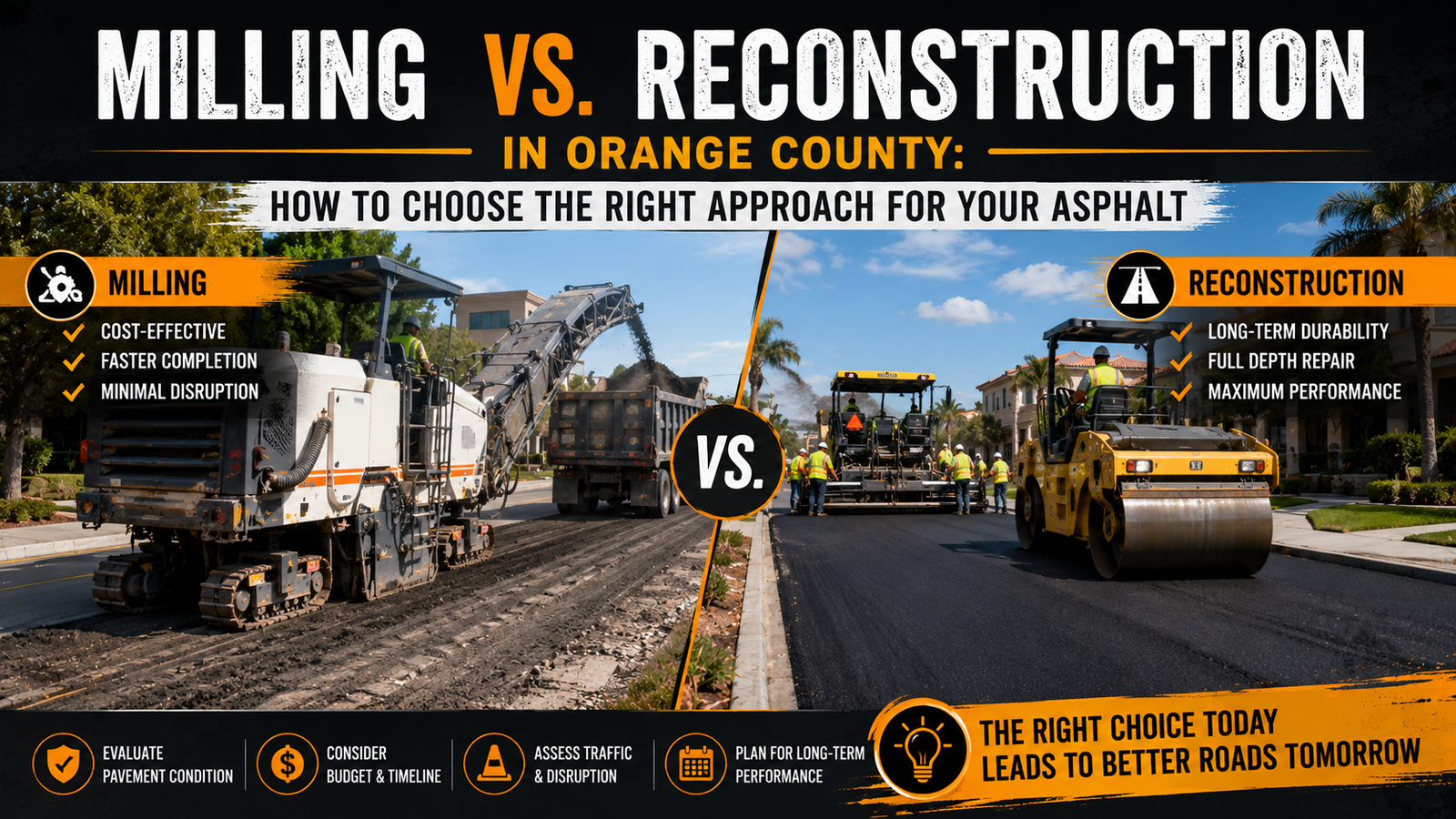
When an asphalt surface in Orange County reaches a condition that requires intervention beyond maintenance, property owners and project managers face a decision that will significantly affect both the project’s upfront investment and the longevity of the result: should the pavement be milled and overlaid, or does the situation require full Milling vs reconstruction Orange County? These two approaches address fundamentally different problems and choosing the wrong one for a given situation either wastes money (reconstruction when milling would suffice) or defers the real problem (milling when reconstruction is actually needed). Understanding the distinction between these approaches, and recognizing which conditions indicate each, is essential knowledge for any Orange County property owner managing asphalt pavement.
What Asphalt Milling Is and How It Works
Asphalt milling also called cold planing, profiling, or rotomilling is the process of mechanically removing the upper layer of an existing asphalt surface using a machine equipped with a rotating drum studded with carbide cutting teeth. The drum grinds the asphalt into small, uniform pieces (called millings or reclaimed asphalt pavement, or RAP) that are conveyed by the machine’s internal belt system into waiting trucks for recycling.
The depth of milling is a critical specification. Typical milling depths range from 1 to 4 inches, removing only the worn or damaged surface layer while leaving the underlying aggregate base and subgrade intact. For projects where the goal is to remove surface defects rutting, surface cracking, raveling, and minor deformations while preserving a sound base structure, milling removes the problem while keeping the investment in base material in place.
After milling, the exposed surface is cleaned, and any remaining localized defects are addressed through base repair or leveling. A new overlay of hot mix asphalt is then placed over the milled surface. The new overlay bonds to the prepared milled surface and, when properly compacted, creates a new wearing course that restores the pavement’s surface performance.
The milled material itself is not wasted reclaimed asphalt pavement (RAP) is one of the most recycled materials in the construction industry. The millings are transported to asphalt plants where they are processed and incorporated into new asphalt mixes, typically replacing 15 to 30 percent or more of the virgin aggregate and binder in new mixes. This recycling makes milling an environmentally favorable approach and reduces the overall material demand of paving projects throughout Orange County’s active construction market.
The Advantages of Milling and Overlay in Orange County
Mill-and-overlay is the appropriate approach for a wide range of Orange County pavement conditions, and it offers meaningful advantages over full reconstruction when those conditions are met.
Cost efficiency is the most immediate advantage. Milling and overlay removes only the damaged surface material, leaving the base investment in place. By contrast, full reconstruction removes the entire pavement structure and rebuilds from the subgrade up paying for materials and labor to create a new base as well as a new surface. For properties where the base is structurally sound, full reconstruction wastes the existing base investment without providing additional structural benefit.
Speed and disruption minimization are particularly important advantages in Orange County’s busy commercial environment. A mill-and-overlay project on a commercial parking lot can often be completed in one to two days, allowing businesses to resume normal operations quickly. Full reconstruction of the same lot may take a week or more. For retail properties, restaurants, and service businesses where parking access is essential to daily revenue, the difference in project duration directly affects business operations.
Grade control and drainage correction are specific capabilities of milling that simple overlay cannot provide. When an existing parking lot has drainage problems areas that pond water, inadequate cross-slope, or elevation issues at curbs and drainage inlets milling allows the contractor to vary the milling depth across the lot to re-establish the correct profile grades before overlay. A simple overlay without milling adds material uniformly and cannot correct grade problems; it may even trap existing drainage issues behind a fresh surface. Milling with profile correction addresses the underlying drainage geometry.
ADA compliance transitions are another area where milling provides critical capability. When an overlay is applied over an existing surface without milling, the grade rise at curbs, building entrances, and door thresholds can create ADA compliance problems the raised grade changes the slope at pedestrian transitions in ways that may exceed accessible design standards. Milling along curb lines and at building entrances (sometimes called edge milling) maintains the existing grade relationship so that the new overlay does not create new accessibility problems.
When Milling Is Not Enough: The Case for Full Reconstruction
Despite its advantages, milling and overlay is only appropriate when the existing base structure is sound. When the base has failed when it has been saturated, destabilized, or compromised structurally an overlay applied over a failed base will replicate the same failure pattern within two to three years. The most expensive mistake in parking lot management is applying a mill-and-overlay to a lot that actually needs reconstruction, then discovering two years later that the new overlay is failing in the same pattern as the old surface.
The key diagnostic indicator is alligator cracking. This pattern interconnected cracks that form polygonal shapes resembling reptile skin is the surface manifestation of base failure. The base has been so thoroughly weakened (typically by water saturation) that the surface can no longer distribute vehicle loads; instead, it cracks into a mosaic of pieces that flex independently. Alligator cracking cannot be fixed from the surface it requires removal of the failed pavement and base material and reconstruction of the structural section.
Other indicators that reconstruction is needed include: areas of significant localized depression or sinking (which indicate base settlement or subgrade instability), soft or spongy pavement that deflects noticeably under load, extensive alligator cracking covering more than 25 to 30 percent of the pavement area, and evidence of base pumping fine base material that has been forced to the surface through existing cracks by water under traffic loading.
Full reconstruction removes the failed asphalt and base material completely, addresses any subgrade issues (improving drainage, stabilizing unstable subgrade soils, or importing suitable fill material), installs a new properly graded and compacted aggregate base to specification, and places new asphalt in the appropriate thickness for the application. The result is essentially a new parking lot with the lifespan and performance of new construction rather than the limited life of a surface repair applied to a compromised base.
Full-Depth Reclamation: The Option Between Milling and Reconstruction
Between mill-and-overlay and full reconstruction lies a technique called full-depth reclamation (FDR), which offers a cost-effective alternative for pavement that has experienced significant deterioration but whose underlying subgrade is still stable. FDR pulverizes the entire existing pavement structure the asphalt surface and the aggregate base beneath it and mixes the combined material with stabilizing agents such as cement, lime, or asphalt emulsion. The result is a new, stabilized base course of uniform thickness that provides a strong foundation for a new asphalt wearing surface.
FDR is particularly valuable in Orange County for parking lots and private roads that have widespread deterioration throughout the pavement section alligator cracking, extensive potholes, and base distress across most of the surface area but where the subgrade below the pavement structure is stable and well-drained. By recycling the existing asphalt and base into a new stabilized base on-site, FDR eliminates the need to haul away failed material and import new base aggregate, reducing both project cost and environmental impact.
The decision between FDR and full conventional reconstruction typically comes down to the subgrade condition and the stabilizing additives available. FDR is not appropriate when the subgrade is unstable or when it requires significant improvement those conditions require conventional reconstruction with subgrade treatment. But for the many Orange County parking lots where the subgrade is stable clay or sand-clay and the failure is concentrated in the asphalt and base layers, FDR can provide a reconstruction-quality result at a meaningful cost savings.
How to Determine Which Approach Your Orange County Property Needs
The diagnostic process for determining whether milling, FDR, or full reconstruction is appropriate for an Orange County parking lot begins with a visual survey and ends with subsurface investigation where needed. An experienced paving contractor walks the lot and evaluates the pavement condition systematically: noting crack types and patterns, identifying areas of alligator cracking or depression, assessing drainage conditions, and evaluating the extent and severity of distress.
For borderline cases lots where surface distress suggests base problems in some areas but not others subsurface investigation through test cores or test pits provides definitive information about the condition of the base and subgrade beneath the surface. A core sample from a sound-looking area adjacent to alligator cracking may reveal that the base beneath the undamaged surface is already saturated and compromised, indicating that more of the lot needs reconstruction than the surface appearance suggests.
The Pavement Condition Index (PCI) a numerical rating from 0 to 100 used by transportation agencies and commercial property managers to assess pavement condition provides a consistent framework for this assessment. PCI ratings above 70 generally indicate pavement suitable for maintenance (sealcoating, crack sealing); 40 to 70 indicates rehabilitation candidates (milling and overlay); below 40 indicates structural distress requiring reconstruction. While private parking lot assessments in Orange County are typically less formal than highway engineering assessments, applying similar systematic thinking to the condition evaluation helps property owners understand the appropriate scope of intervention.
Orange County-Specific Considerations for Milling vs. Reconstruction Decisions
Orange County’s commercial real estate environment creates specific factors that should inform the milling vs. reconstruction decision beyond pure structural assessment. The high value of commercial properties throughout the county Irvine, Newport Beach, Anaheim, and other key commercial markets means that inadequate pavement that deters customers or creates liability exposure carries real financial consequences.
California’s ADA enforcement environment is particularly active. “High-value” ADA demand letters and lawsuits targeting commercial properties with accessibility compliance issues are common throughout the state. Any significant pavement modification project whether milling and overlay or reconstruction should incorporate an ADA compliance review and any necessary improvements to accessible parking spaces, access aisles, and pedestrian pathways. The cost of incorporating ADA improvements into an active paving project is typically a fraction of the cost of retrofitting them afterward.
CalRecycle and California’s sustainability requirements have made RAP incorporation increasingly standard in California asphalt mixes. Orange County paving contractors working on mill-and-overlay projects should be using asphalt mixes that incorporate reclaimed asphalt pavement from the milling operation, aligning with California’s construction materials sustainability goals.
Common Questions About Milling vs. Reconstruction in Orange County
How do I know if my parking lot needs milling and overlay or full reconstruction? The key diagnostic question is whether the base is sound. Alligator cracking is the most reliable surface indicator of base failure. Areas that feel soft or springy, that have significant depression, or that show “pumping” of base material through cracks are additional base failure indicators. If your lot shows widespread alligator cracking more than 25 percent of the surface area reconstruction rather than overlay is likely the appropriate approach.
How long does a mill-and-overlay project last in Orange County? When applied over a sound base with proper preparation, a quality mill-and-overlay project in Orange County typically extends the pavement’s service life by 8 to 15 years, depending on traffic loading and maintenance. With regular sealcoating and crack repair during that period, the upper end of this range is achievable.
Can milling correct an uneven parking lot surface in Orange County? Yes. Variable-depth milling grinding more material in high spots and less in depressions corrects surface irregularities and improves drainage grades. This is one of milling’s key advantages over simple overlay, which follows the existing surface contour and cannot correct geometric problems.